
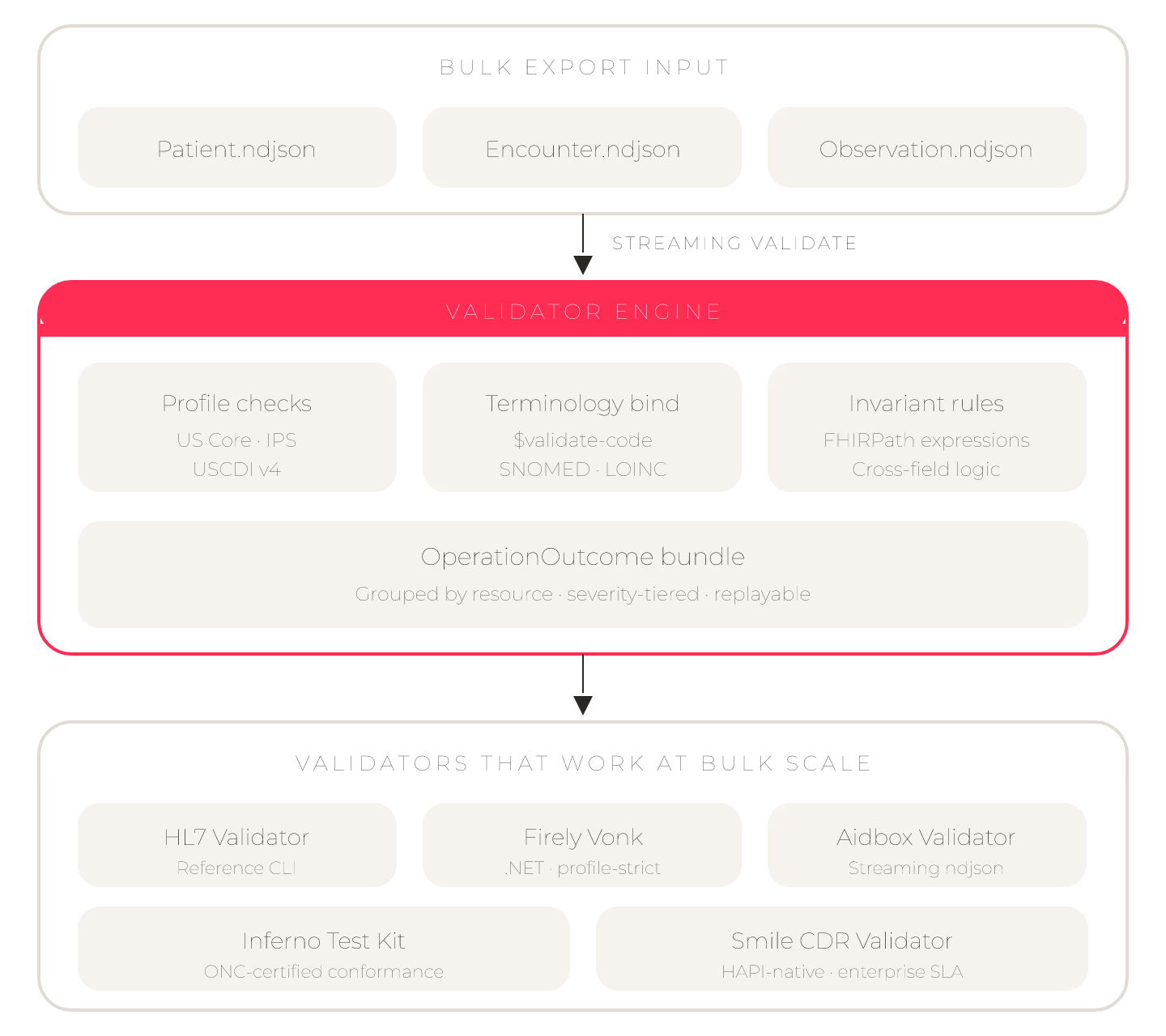
Bulk data submissions are the validation use case where single-resource validators show their limits. An NDJSON file with a million Patient and Observation resources is a throughput problem before it is a validation problem, and a validator that takes the wrong shape turns a one-hour ingest into a one-day backlog. The four tools below handle bulk data validation as a first-class workflow in 2026, not as a stretch of the per-resource API. The complete guide to FHIR validators covers the broader frame.
For more reviews of this kind, more FHIR product comparisons is the place to keep the shortlist building.
The Validators That Handle Bulk Cleanly
- HAPI FHIR Validator. The Java library form runs inside a single JVM with a warm validator instance, which makes it the natural fit for a bulk pipeline that streams NDJSON and validates each resource without per-call startup cost.
- Pathling. The Spark-based engine treats bulk validation as a partitioned computation. Suits payer and HIE bulk pipelines where the corpus is large enough that single-JVM throughput is the bottleneck.
- Aidbox. The server's
$validateoperation paired with a server-side bulk-ingest path lets a team validate as part of the ingest, with the validator and the server sharing a process.
- Firely Server. For .NET-based bulk pipelines, Firely Server exposes a validator that can run alongside the ingest with reasonable throughput.
What Bulk Validation Demands That Per-Resource Validation Does Not
Three things change when the workload is bulk rather than per-resource.
The first is warm-validator economics. A per-resource validator can spend a second initializing on each call; a bulk validator cannot. Tools that ship only a CLI form (every invocation pays JVM startup) are operationally unsuited for bulk unless they are wrapped in a long-lived service. The top 5 FHIR validators for $validate REST operations review covers the related REST-service shape.
The second is the failure-handling model. A per-resource validator either passes or fails; a bulk validator has to decide what to do with a 50,000-resource batch where 12 resources fail. The right shape is per-resource error reporting with a summary OperationOutcome, so the upstream system can quarantine the failing resources and accept the rest. Validators that fail the whole batch on a single resource are operationally hostile.
The third is parallelism. A bulk validator either parallelizes naturally (Pathling's Spark model, HAPI's library form inside a multi-threaded JVM) or it serializes the workload through a single bottleneck. The serialized option works at small scale and falls over above a million resources.
How to Pilot for Bulk Specifically
The pilot is straightforward. Assemble a synthetic NDJSON bundle of 100,000 resources with a known 5% invalid rate (intentionally planted profile errors of the same shape the real workload will encounter). Run each candidate validator and measure throughput, the catch rate on the planted errors, and the shape of the error report. A validator that completes in minutes with full catch rate and per-resource error reporting is a serious contender. For the related SMART on FHIR app-review workflow where bulk patterns sometimes appear, the top 4 FHIR validators for SMART on FHIR app reviewers review covers the adjacent case. Bulk validators are the layer where vendor claims diverge most sharply from production behavior, so the pilot has to use realistic resource volumes rather than a 100-resource toy set.
Sources
- FHIR Bulk Data $export specification - spec, HL7, evergreen
- HAPI library Instance Validator - docs, HAPI, evergreen
- Resource $validate operation definition - spec, HL7, evergreen